29.09.2026
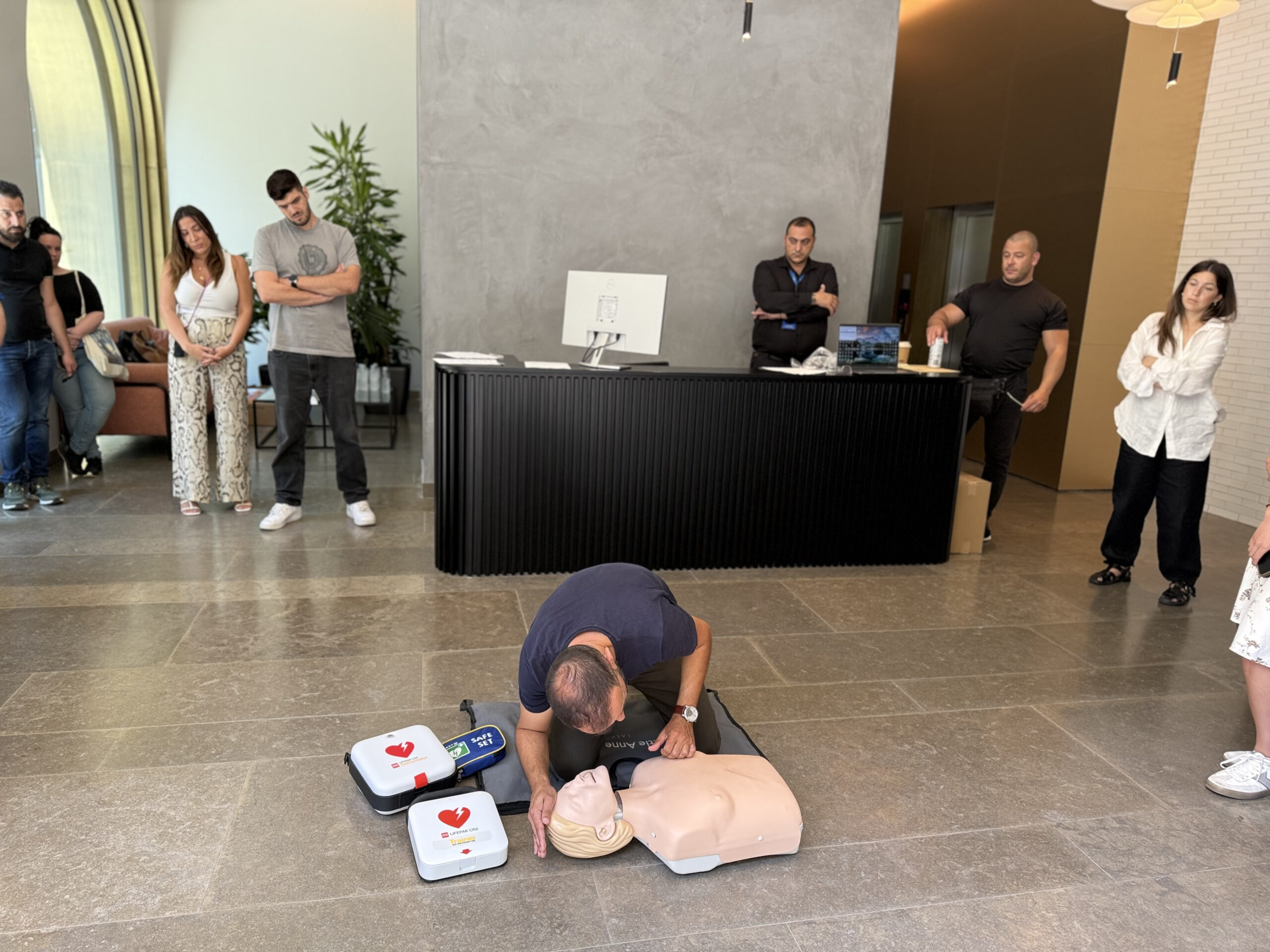
In the event of cardiac arrest, every minute counts. Knowledge, composure and immediate access to the right equipment can make all the difference.
World Heart Day provides an opportunity to talk about prevention. But also about something equally important: preparedness. About how the places where we work, move around and spend a significant part of our everyday lives have the resources and the people needed to respond to an emergency.
It is this dimension of prevention and preparedness that DIMAND is investing in, having procured and installed Automated External Defibrillators (AEDs) in buildings it has developed, including MINION and Piraeus Tower, as well as at its headquarters in Marousi. The devices can be used for both adults and children. As Vicky Anagnostopoulou, Head of CSR & Procurement at DIMAND, notes: “For us, prevention is an expression of responsibility towards our people and the communities around the developments where we operate. Knowledge and the right equipment, at the critical moment, can save a life. That is why we invest not only in the right equipment, but also in training our people so that they know how to respond when needed. Because every heartbeat counts.”
Alongside their installation, the defibrillators were registered on the National Defibrillator Map of KIDS SAVE LIVES, making it possible to locate them and navigate to them in an emergency. Through the iSAVElives app, users can currently locate approximately 3,700 registered defibrillators. According to KIDS SAVE LIVES, when CPR is initiated immediately and a defibrillator is used within the first two minutes of cardiac arrest, survival rates can reach up to 80%. To date, the organisation has recorded 44 cases in which victims of cardiac arrest were successfully resuscitated through its work.
Equipment alone is not enough. A defibrillator may be just a few metres away. But if we do not know where it is or how to respond when every second counts, its presence alone is not enough.
That is why DIMAND has placed particular emphasis on training. Company employees, as well as employees of other companies housed in the respective buildings, are trained in Cardiopulmonary Resuscitation (CPR) and the use of an Automated External Defibrillator. Equally important is that training is not treated as a one-off initiative, but is repeated annually. In this way, each device is surrounded by something more valuable than a safety infrastructure: a community of people who know how to respond when it matters most. And this knowledge extends beyond the workplace, becoming part of their everyday lives and strengthening preparedness wherever and whenever it may be needed.
The same approach underpins the work of KIDS SAVE LIVES, which has so far trained 500,000 children and 160,000 adults, with the aim of equipping more and more people with the knowledge and skills that can prove critical in an emergency. For DIMAND, caring for people does not end with the design and development of a modern and functional building. It extends to its everyday use and to ensuring the safety of the people who work, move through and engage with it. Because a defibrillator delivers its true value when it is available at the moment it is needed—and, above all, when there are people who know how to use it.
World Heart Day reminds us that caring for our hearts starts with prevention. When an emergency does occur, however, preparedness can make all the difference: having the right equipment, in the right place, and a person who knows what to do.
related projects

Piraeus Tower

MINION
Neratziotissa Office Complex